FinOps
Marketplace Governance in Azure: Balancing Control and Enablement
Explore how organizations can govern Azure Marketplace effectively by balancing control and enablement through policy, procurement alignment, and phased FinOps-driven maturity.
A Familiar Governance Challenge
In many conversations with clients, one topic keeps coming back: how to properly govern the Azure Marketplace. What often starts as a practical way to accelerate delivery can quickly become a broader governance challenge. Costs become harder to track, security questions begin to surface, and accountability becomes less clear over time.
Different organizations, across industries and maturity levels, are facing similar questions:
- Who should be allowed to purchase from the marketplace?
- How do we control costs without slowing innovation?
The Azure Marketplace sits between engineering, procurement, and platform governance. Left unmanaged, it introduces risk. If it is too restricted, it slows teams down.
So, the challenge is not whether it should be controlled. The challenge is how to govern it in a way that still enables teams to move forward.

Understanding the Azure Marketplace
The Azure Marketplace is often seen as a catalogue of solutions. In practice, it is much more than that.
It combines procurement, deployment, and integration into a single experience. Through the marketplace, organizations can acquire and deploy a wide range of offerings, including:
- Virtual machine images and infrastructure components
- SaaS applications and external services
- Managed applications that deploy complete architectures
- Containers and Kubernetes-based solutions
- Developer tools and APIs Many organizations also work with private offers, custom agreements with vendors that include negotiated pricing and contract terms. This variety is what makes the marketplace valuable. But it is also what makes it difficult to govern.
A VM image, a SaaS subscription, and a private enterprise deal may all appear in the same portal, but they carry very different implications in terms of cost, ownership, security, and operational impact. That is exactly where governance becomes necessary.
Why Marketplace Governance Matters Without governance, marketplace usage quickly becomes fragmented and difficult to control.
What begins as isolated usage can gradually evolve into something much harder to manage. Teams adopt tools independently, costs become less visible, and technical choices begin to spread without clear ownership or review.
A few common risks tend to show up repeatedly:
- Uncontrolled spending: Teams can provision paid services without clear budget ownership
- Security exposure: Not all marketplace offerings meet internal security standards
- Compliance challenges: External services may process or store data outside required boundaries
- Operational inconsistency: Different teams may adopt overlapping or conflicting solutions
- Shadow IT: Teams may bypass established processes when governance feels too restrictive
- Duplicate capabilities: Solutions may be purchased that replicate tools already available within the organisation
- Acceptance of non-approved terms and conditions: Marketplace purchases may be made under vendor terms that have not been reviewed or accepted by the organization
- Paying list price where contractual discounts already exist: Solutions may be purchased directly through the marketplace at list price, even when enterprise agreements or negotiated pricing are already in place
At its core, the marketplace introduces a form of decentralized procurement. Engineers can effectively make purchasing decisions at deployment time, often without the involvement of finance or procurement teams. This is not just a governance challenge, but also a natural characteristic of cloud environments, where infrastructure and cost are directly linked.
How to Restrict Access Without Blocking Progress
One of the first questions organizations usually ask is simple: How do we control access?
That is the right question, but it needs to be approached carefully. The objective should not be to block marketplace usage entirely. It should be to control it in a structured and workable way.
In practice, that usually means combining multiple control layers. If you think of the Azure Marketplace like a restaurant, governance is not just about deciding what is available. It is also about who can order, how it should be prepared, and who is responsible for the bill.
That is where the following control layers come together.

1. Private Marketplace: What’s on the Menu?
The Azure Private Marketplace allows organizations to create a catalogue of approved third-party offers. In simple terms, this is your menu.
It determines which third-party solutions are visible and available to users in the first place. That means:
- Only approved third-party solutions are visible to users
- Unapproved third-party offers are hidden
- New ISV offers must be explicitly added to the catalogue
This helps establish a default deny model for third-party marketplace solutions and creates a more controlled user experience. But there is an important limitation.
Microsoft-published offerings are automatically approved and cannot be governed through Private Marketplace.
So, while Private Marketplace is a strong starting point, it is not a complete governance solution on its own.
Implementation guidance for configuring and managing a Private Azure Marketplace can be found here.
2. Role-Based Access Control (RBAC): Who Can Order?
Once something is on the menu, the next question is: who is allowed to order it? That is where RBAC comes in. RBAC determines who can deploy or purchase marketplace offerings and under what level of responsibility.
A common governance pattern is to separate usage from purchasing authority. For example:
- Developers can deploy approved solutions
- Only specific roles can initiate purchases or subscriptions
- Approval, deployment, and ownership are not handled by the same person This creates a clearer separation of duties and helps prevent accidental or unmanaged consumption.
3. Azure Policy: How Should It Be Prepared?
Even if a solution is allowed and the right person is deploying it, that still does not mean it should be deployed in any way, anywhere. That is where Azure Policy adds control.
If Private Marketplace defines what is available, Azure Policy defines how it can actually be used.
Typical use cases include:
- Restricting deployments based on resource type, SKU, location, or configuration
- Enforcing tagging and configuration standards
- Blocking non-approved resources or deployment patterns This becomes especially important for Microsoft offerings, since those remain visible even when Private Marketplace is enabled.
4. Financial Controls: Who Pays the Bill?
The final question is often the one that gets attention the fastest: who is paying for it? Marketplace governance is closely connected to cost management.
Even when a deployment is technically allowed, it still needs to be financially visible and accountable.
Organizations typically support this through:
- Subscription-level purchase restrictions
- Budgets and alerts
- Cost ownership through tagging and allocation
Without that layer, marketplace usage can become much harder to track financially, especially when SaaS subscriptions or vendor-managed services are involved.
Governance Models: Finding the Right Balance
When organisations start governing marketplace usage, they usually move toward one of three operating models. Each comes with a different balance between flexibility and control.
| Model | Description | Advantages | Trade-offs | Key Controls |
|---|---|---|---|---|
| Fully Open | Users can access and deploy marketplace offerings without meaningful restrictions | • High flexibility • Fast innovation • Minimal friction |
• Limited control • Higher financial risk • Increased security exposure |
• Basic RBAC • Cost monitoring (budgets, alerts) |
| Fully Restricted | Marketplace access is blocked or tightly controlled unless explicitly approved | • Strong control • Easier compliance • Reduced risk |
• Slows teams down • Higher operational overhead • Encourages workarounds |
• Azure Policy • Strict RBAC • Manual approval processes |
| Controlled Access (Recommended) | Access to approved offerings with layered technical and process controls | • Balanced control and flexibility • Reduced risk • Better user experience |
• Requires ongoing maintenance • Needs clear approval process |
• Private Marketplace • RBAC • Azure Policy • Approval workflows • Cost management & tagging |
In practice, most enterprise organizations eventually move toward the controlled Access model, as it tends to provide the best balance between control and enablement.
A Practical Example
A common example is when a platform or engineering team wants to deploy a third-party solution from the Azure Marketplace to solve a real delivery challenge.
Let’s say a team wants to deploy a security appliance, observability tool, or Kubernetes add-on because it helps them move faster or close a capability gap.
From their perspective, the solution is logical. It is available in the marketplace, technically easy to deploy, and solves an immediate need.
But from a governance perspective, several questions still need to be answered:
- Has the solution been reviewed from a security perspective?
- Is there already an equivalent capability available internally?
- Who owns the cost once it is deployed?
- Is it allowed in production, or only in specific environments?
- And if it is approved once, does that mean every team should be able to use it?
This is where governance often becomes difficult in practice. Because the team requesting the solution is usually not trying to bypass governance. They are simply trying to move. And if the governance model does not give them a workable path, the pressure to find alternatives increases quickly.
That is exactly why marketplace governance needs to do more than just restrict access. It needs to create a clear way to decide:
- Whether a solution is allowed at all
- Under which conditions it can be used
That is where a more structured approval model starts to make a real difference.
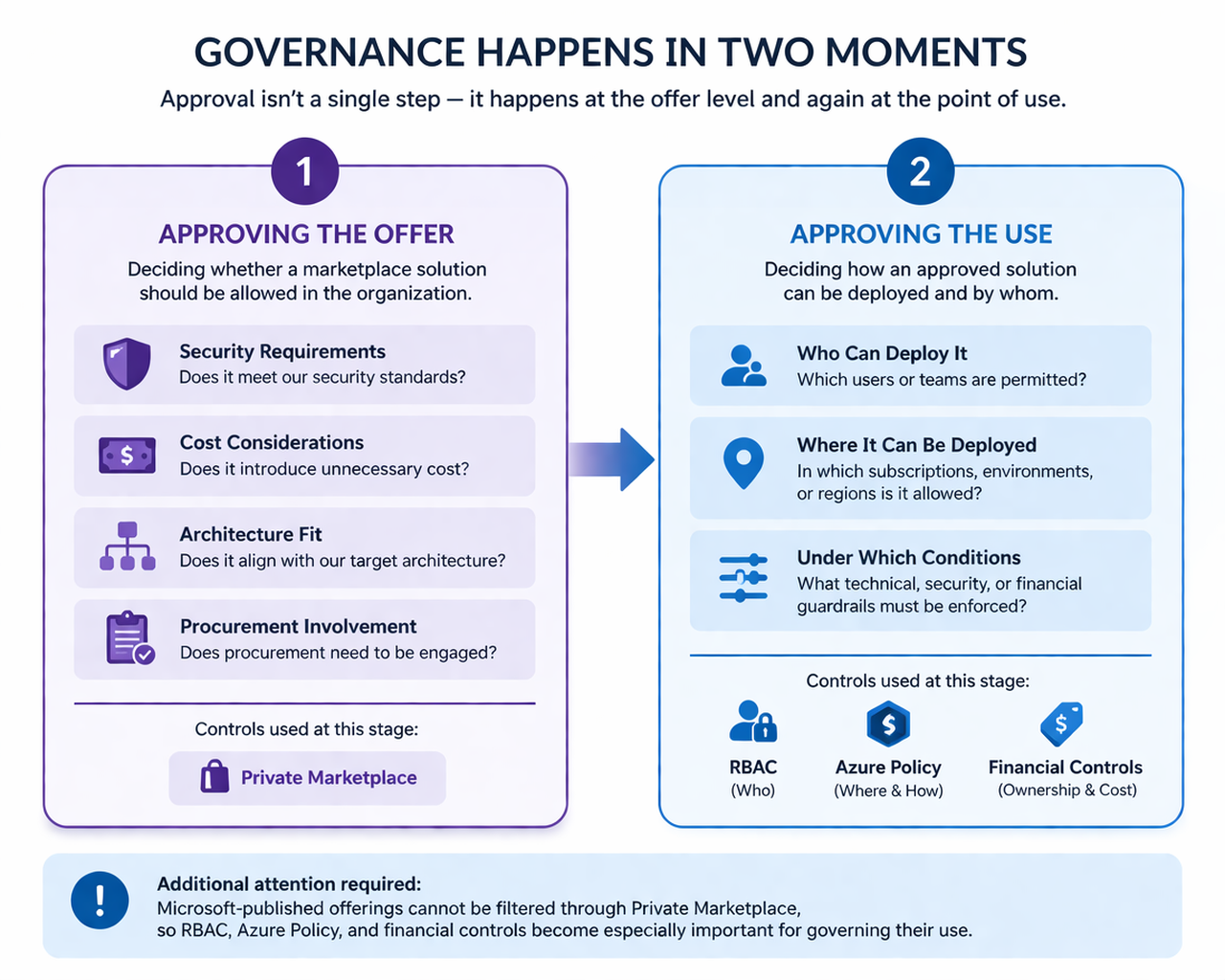
Governance Happens in Two Moments
One thing that often creates confusion in marketplace governance is that approval is treated as if it only happens once. In practice, that is usually not enough.
Even if a marketplace solution is approved for organizational use, that still does not mean it should automatically be deployable by everyone, everywhere, and under all conditions. That is why governance usually needs to happen in two moments.
The quick reference below provides a simple visual summary of how governance operates at both stages.
Final Thought: Governance Should Create Clarity, Not Friction
The Azure Marketplace is a powerful enabler, but only when used with the right level of governance.
Organizations can restrict access, but restriction alone is not the answer. Effective governance requires a more balanced approach that combines visibility, control, and enablement. The most successful organizations recognize that marketplace usage is not just a technical decision. It is a shared responsibility across engineering, finance, procurement, security, and governance teams.
The risks are real, but they can be managed with the right structure in place
So, the real question is not: “Should we allow marketplace usage?” It is:“How do we enable the right usage, with the right controls, for the right people?”
That is where effective marketplace governance begins.
To move from principle to practice, the quick reference below illustrates a maturity-based approach to marketplace governance. In line with the FinOps framework, organizations should build these capabilities progressively establishing core controls first, then expanding toward broader automation, accountability, and scale.
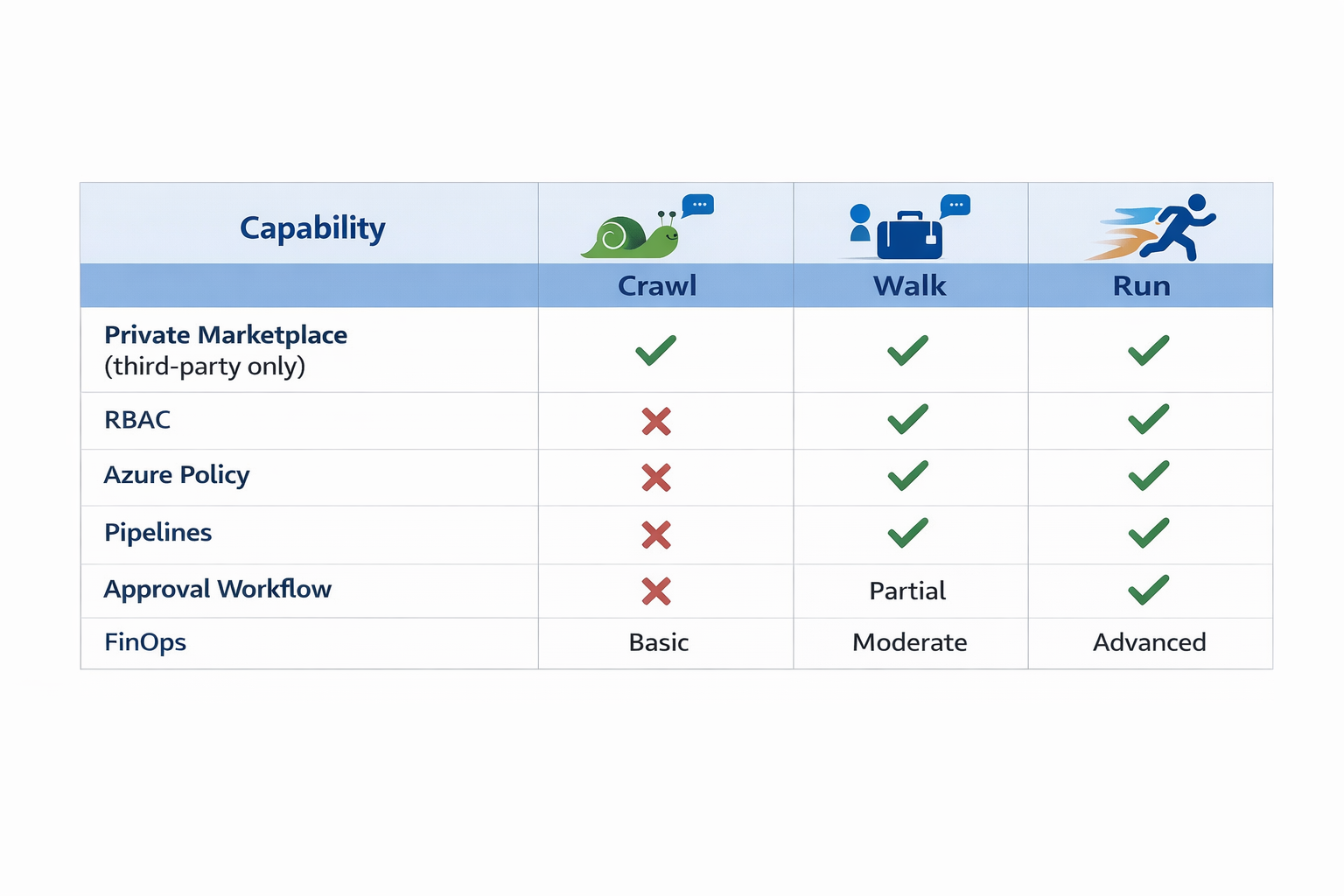
Table of contents