
In plain language
What is Amazon Bedrock?
Amazon Bedrock is a fully managed AWS cloud service that gives you access, through one AWS service, to many leading foundation models for generative AI. You call them from your own AWS account and manage no AI infrastructure or servers yourself.
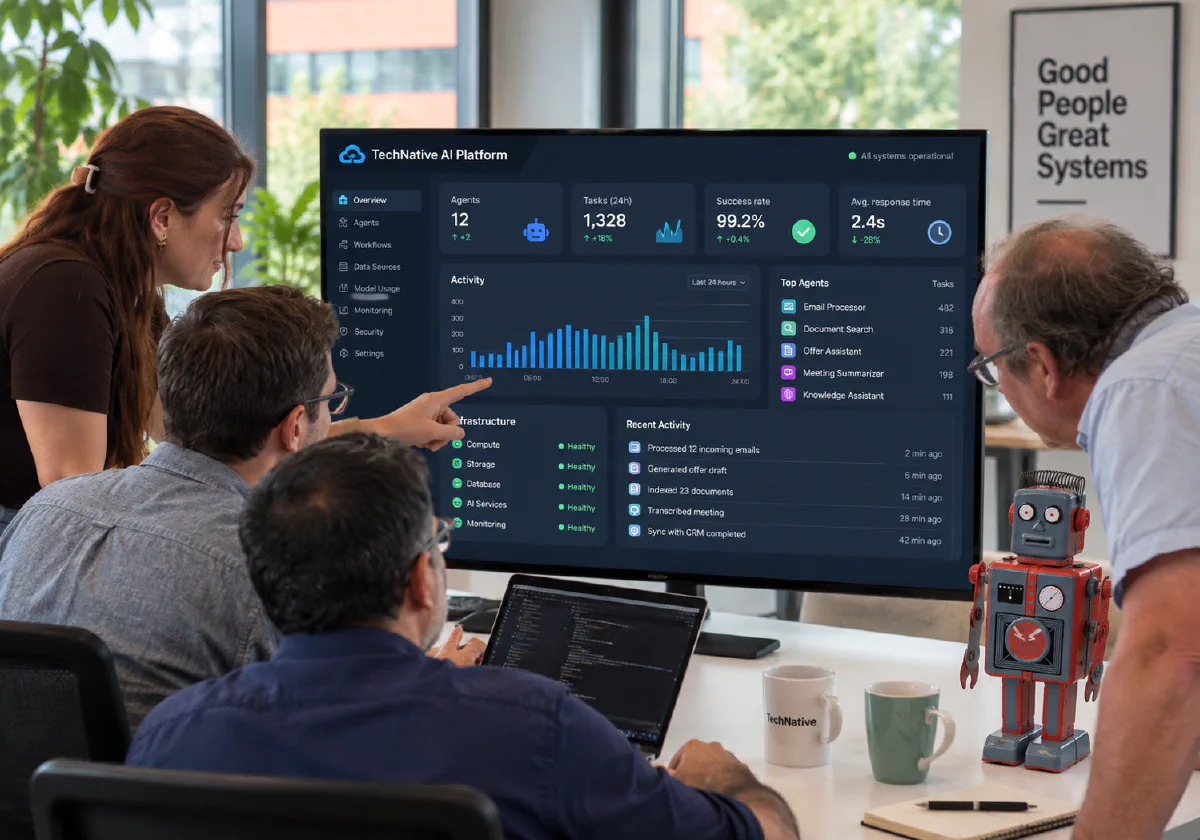
Bedrock in brief
One entry point, fully managed, per token
One entry point
Multiple models through the same AWS service, which makes switching easier than with separate vendors.
0 servers
Fully managed. No GPUs, no scaling to manage, no updates you run yourself.
EU region
You use Bedrock from your own AWS account and, for supported models, choose a European region.
Per token
You pay for what the model reads in and gives back. Nothing used is nothing paid.
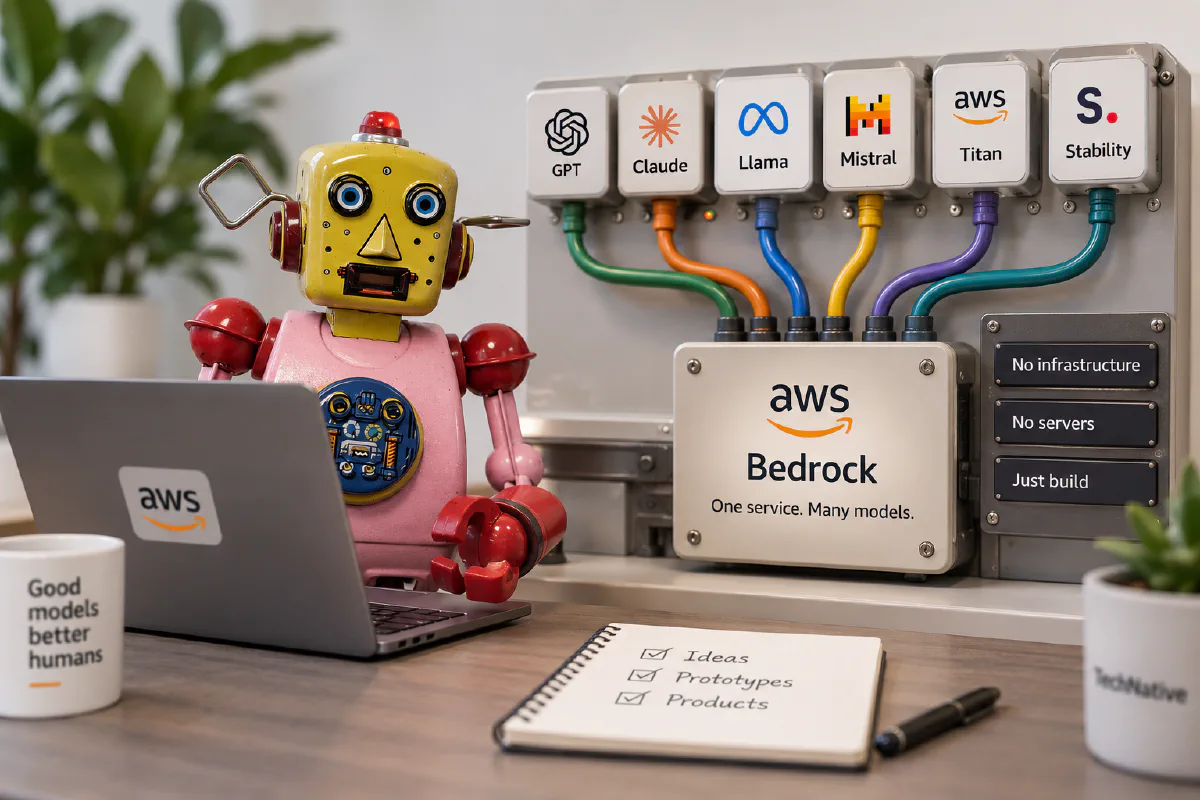
How it works
One service, multiple models, cost per token
What does Bedrock actually do?
Say you want a language model to summarise quotes. Without Bedrock you pick a provider, create an account, send your documents to their servers and hope the model still exists a year from now.
With Bedrock you switch on one AWS service. Behind it sit foundation models from Anthropic, Meta, Mistral, Cohere and Amazon itself, among others. You call them through the same service, your documents stay under your control, and the monthly amount lands on your existing AWS invoice.
No longer happy with a model, or a cheaper one comes along? Then you switch within the same service. Testing is still needed, because models differ in capabilities and behaviour, but it is not a migration to another vendor.
Models in Bedrock
Claude for long documents, careful text and reasoning over context. Nova, Amazon’s own models, sharply priced for high volume. Llama, the open models from Meta. Mistral, small and fast, fine for classifying and routing.
Which models are available differs per region, and not every model supports the same features. The offering keeps growing, and new models arrive without you having to move to another vendor.
Per token, not per month
A token is a small piece of text; how many tokens a sentence contains differs per model and per language. You pay for what goes in and what comes out. No licence, no minimum commitment, no unused seats. That makes small experiments cheap and large rollouts predictable, provided you steer on it.
With many models a simple summary costs a few cents, depending on model, document length and answer. The difference between a small and a large model adds up quickly, and often the small one is enough.
Use cases
What can you do with it?
Five things companies most often build on Bedrock in practice.
Generate text and chat
Build smart chatbots, write emails automatically or summarise large documents with models such as Anthropic Claude or Meta Llama.
Images and graphic design
Generate images or visual content from a text description.
Customise models
Fine-tune supported models with your own company data, so the answers fit your organisation specifically. Which customisation is possible differs per model.
Build AI agents
Autonomous systems that carry out complex tasks by connecting to business systems and databases.
Work securely
You use Bedrock within the security boundaries of AWS. Model providers have no access to your prompts and answers, and AWS does not use that content to train the foundation models.
FAQ
Frequently asked questions about Amazon Bedrock
Want to know what suits your situation best? Ask Pim. Pim Snel leads migration and modernisation at TechNative. Describe your current environment and you get a straight answer about what does and does not apply, including when doing nothing is the cheaper option. Book a moment with Pim or one of the team.

-
No. Bedrock is not a chatbot for end users, but an AWS service that lets you use different AI models in your own applications and processes.
-
Not literally. You call Amazon Bedrock from your own AWS account, and the models run as a fully managed AWS service on AWS infrastructure.
-
No. AWS does not use your prompts and answers in Amazon Bedrock to train the foundation models, and model providers have no access to them. For certain models separate rules apply for abuse detection and temporary retention, so record per use case which models and configuration are allowed. Read more about the AWS sovereignty options
-
Yes, and Bedrock makes that easier because multiple models are available through the same AWS service. A model switch does need to be tested, because models differ in capabilities and in behaviour.
-
Not on its own. You decide which data and which systems your application opens up, and which IAM permissions are granted for that. See the SME AI Platform
-
Yes, Bedrock is available in European AWS regions, but availability differs per model and per feature. So check per use case which region and which inference configuration is used.
Further reading
Where to read on
SME AI Platform
A ready-to-use AI platform on an AWS foundation, in your own account, switched on module by module.
AI Prototyping Sprint
In five working days from idea to a working prototype that is in use.
TechNative's AI services
How we set up an AI engagement, and why engagements usually do not get stuck on the technology.
Get started
Switching Bedrock on is an afternoon's work. Doing something useful with it is the art.
Pick one recurring job, and in a few weeks we build a working module on your own data. The AI Readiness assessment is often funded by AWS.